










AI changed marketing before most marketing teams changed how they work. The biggest shift is not that we can write faster, generate more visuals or produce more versions of an ad. It is that customers are learning to expect faster answers, more relevance, more context and new ways to discover brands. The useful question is no longer only “what can AI generate?” It is “what changed in the customer because AI exists?”
Why is content generation only the smallest part of the change?
Because speed increases output, but it does not automatically improve the decision behind the output. In 2023, when AI started becoming a more serious part of my work, most conversations began in the same place: faster captions, faster copy, more visuals, more variations. I understood the excitement. A team could produce in minutes what used to take hours. But I kept feeling that we were looking at the smallest part of the change.
It reminded me of the early days of social media. Companies initially focused on having a page and posting every day. The platform was new, but the bigger shift was behavioral: people had changed how they discovered brands, compared options, talked to companies and made decisions. AI is doing something similar now.
McKinsey now describes a shift from isolated AI use cases toward a more continuous marketing model built around insight, creativity, personalization, commerce and orchestration. Its 2026 research says many marketing organizations are experimenting with AI, but relatively few have scaled it across workflows. The difference is not how many AI tools are available. It is whether the business has changed the way work, data and decisions connect.
The easier it becomes to generate things, the more valuable judgment becomes.
How is AI changing customer expectations?
AI is raising the standard for speed, relevance and two-way interaction. Customers are getting used to asking a question and receiving a useful answer immediately. They increasingly expect search to understand intent, service to remember context, recommendations to feel relevant and digital experiences to respond instead of simply broadcasting.
Salesforce’s 2026 State of Marketing research, based on 4,450 marketers, found that 83% say customers increasingly expect two-way conversations with brands, while 69% say they struggle to respond promptly. The same research points to fragmented or irrelevant data as a major barrier to delivering that level of personalization.
That changes marketing because the customer journey is becoming less linear. Someone might discover a brand through a creator, ask an AI assistant to compare it with competitors, check reviews, visit the website, ask a chatbot a specific question and only then decide whether the product deserves attention. Marketing has to work across that path, not only at the moment an ad is served.
Why does context matter more than the AI model?
Because similar tools can produce very different results depending on what the business gives them to work with. Clean product information, customer history, market knowledge, CRM data, brand rules, sales feedback and operational reality create context. Without that, AI can produce something polished that is still generic or wrong for the business.
This is where I think many companies will get stuck. They will buy the AI tool before fixing the information underneath it, then wonder why the personalization feels shallow or why answers are inconsistent. AI does not magically create business knowledge. It amplifies the quality of the context it receives.
That is also why data should change decisions instead of decorating presentations. Useful AI depends on information that can actually influence what happens next, not only on dashboards that report what already happened.

How is AI changing search and discovery?
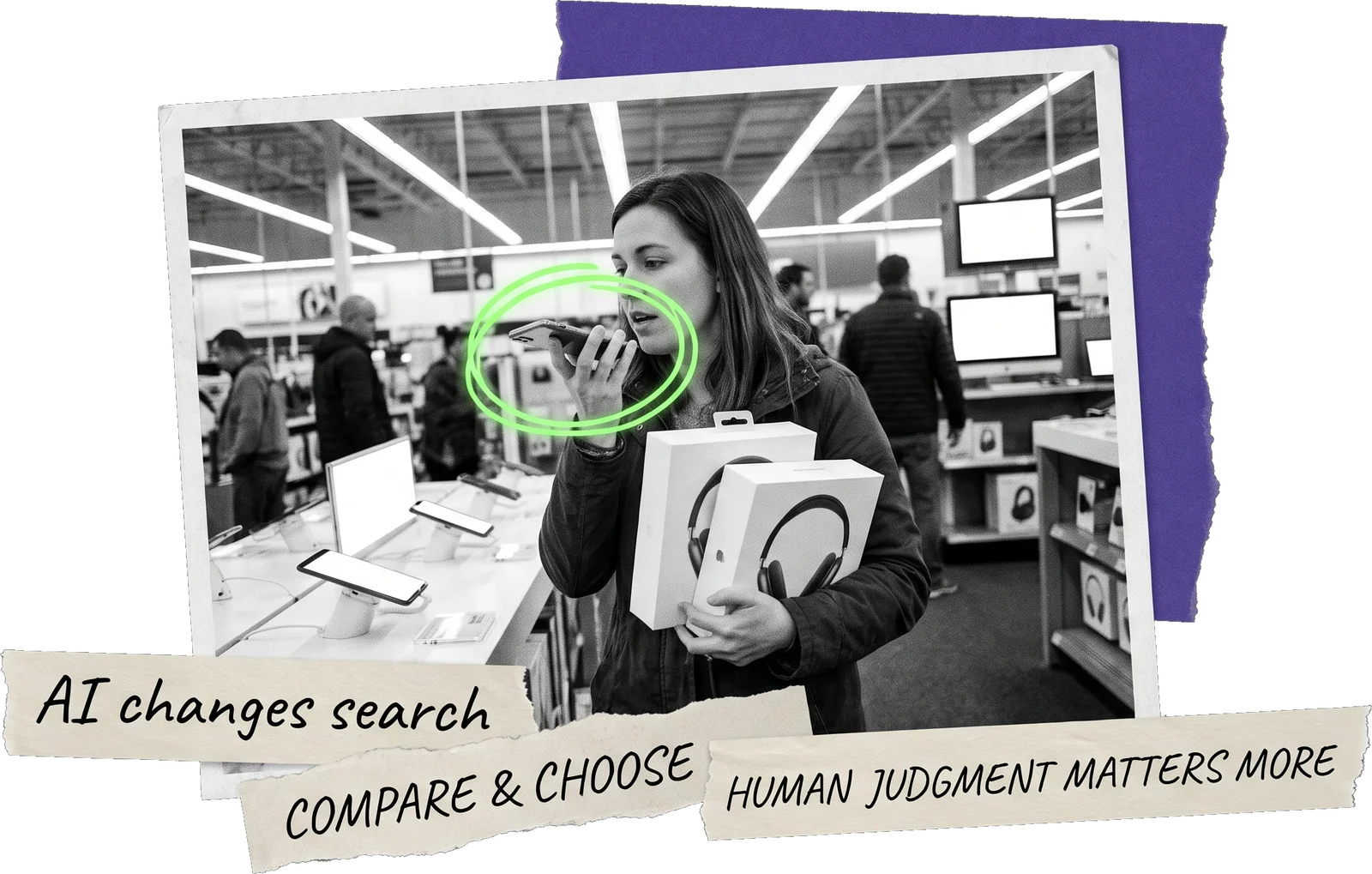
Search is becoming more conversational, multimodal and answer-driven. People are not only typing short keywords. They are asking longer questions, using images and voice, comparing options in natural language and expecting the system to assemble useful answers for them.
Google describes Search in 2026 as increasingly conversational and built around complex questions and discovery, while new AI-powered ad formats are being designed to appear inside those answer experiences. Google says its AI-era Search products are changing how people research and evaluate products and services. McKinsey makes the same broader point: consumers are increasingly discovering, evaluating and purchasing through intelligent systems.
That means clear positioning, accurate product information, useful content, credible references and consistent facts across the web matter even more. The old question was often “how do we rank for this keyword?” The new question is broader: when someone asks an AI system for the best solution to a problem, does the available information give that system a reason to understand, trust and include the brand?
Does AI make human judgment less important?
No. When generation becomes cheap and abundant, judgment becomes a bigger differentiator. If everyone can generate fifty campaign ideas, choosing the one worth making matters more. If everyone can create a polished image, taste matters more. If every company can automate a response, knowing when a person should step in matters more.
Culture, timing, humor, empathy, commercial instinct and the ability to read a room are still difficult to reduce to a prompt. AI can create options and accelerate work. It cannot decide what a brand should stand for, what risk is worth taking or which idea is right for this market, this audience and this moment. Those are still strategic choices.
This is also where integrated marketing matters. AI can optimize pieces of a campaign, but the business still needs a coherent strategy connecting the channels, customer journey and commercial goal. That is the same problem behind 360 marketing without strategy: better tools cannot compensate for a system that is pointing in different directions.
What should marketing teams do next?
Start by improving the system around AI, not by collecting more AI tools. The practical advantage comes from connecting the technology to the business, customer and decision-making process.
- Fix the context first. Organize product information, customer data, brand rules and internal knowledge before expecting AI to personalize or answer accurately.
- Map where AI already touches the customer journey. Look at search, recommendations, service, comparison, content discovery and purchase decisions, not only internal content production.
- Separate automation from judgment. Automate repetitive work where it helps, but keep human review around positioning, sensitive communication, creative direction and important commercial decisions.
- Design for conversations, not only campaigns. Make it easy for customers to ask, compare, respond and continue the journey instead of forcing every interaction into one-way communication.
- Measure business impact. Track whether AI improves relevance, response time, conversion, customer experience, productivity or decision quality, not simply how much content it produces.

Final thoughts
AI changed marketing, just not because it can write a caption in three seconds. It changed the speed people expect, the way they search, the amount of context brands need to organize and the value of good human judgment.
The companies that understand that will use AI to make marketing smarter. The ones that do not will mostly use it to make more noise, faster.
See you,
Tai Perez