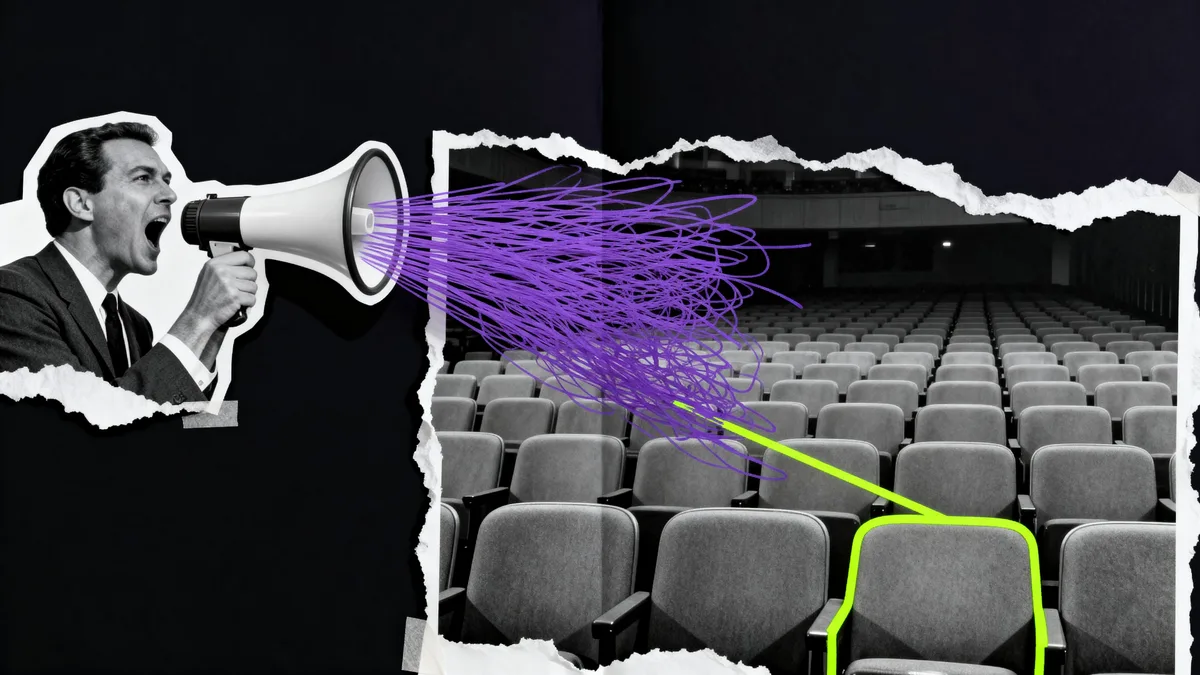











I see a lot of presentations that are technically complete and strategically empty. The slides are there. The charts are there. The research is there. The team has spent weeks polishing the story. Then the meeting ends and the audience still does not know what they are supposed to believe, approve, fund, stop, change or do next.
That is the part most people do not communicate. They present the work instead of presenting the decision. A pitch deck becomes a tour of the company. A business plan becomes a document archive. A marketing plan becomes a channel list. A research presentation becomes a collection of findings. All of those can be accurate and still fail.
The presentation should not prove how much work you did. It should make the logic easy to follow and the decision hard to misunderstand.
Why do so many presentations feel complete but still go nowhere?
Because completeness and usefulness are not the same thing. Most teams build presentations from the inside out: they start with everything they know and then try to fit it into slides. The audience experiences the opposite problem. They are trying to understand what matters, what changed, what choice is in front of them and whether the evidence is strong enough to act.
McKinsey has made a similar point about communicating decisions inside organizations: people need more than the decision itself. They need the why and the implications, because context helps them understand how to carry the decision out. That logic applies before the decision too. A useful presentation gives the audience enough context to make the choice, not every fact the presenter collected. (McKinsey: Decision making in your organization: Cutting through the clutter)
Harvard Business Review has also documented how executive meetings can become performative report-outs instead of forums for real strategic choices. That is exactly the trap: reporting activity feels productive because there is a lot to show, but the real job is to help the room decide.
Most weak presentations are not missing more slides. They are missing the decision architecture.

What are people actually trying to understand?
The answer changes by audience, but the questions are surprisingly consistent. Investors, boards, lenders, clients and leadership teams all need a version of the same logic: What is happening? Why does it matter? What do you recommend? Why should I believe you? What are the risks? What does it cost? What happens if we do nothing? And what exactly do you need from me?
| Presentation type | What the audience is really deciding | What often gets over-presented | What is often missing |
|---|---|---|---|
| Pitch deck | Should I keep listening, invest, introduce, or diligence further? | Features, market-size headlines, founder background. | Unique insight, proof, business model, why now, use of funds, milestones, direct ask. |
| Business plan | Is this business viable, financeable and executable? | Company description, long research sections, optimistic forecasts. | Assumptions, unit economics, cash needs, operating logic, downside cases, decision points. |
| Marketing plan | Is this the right use of budget to move the business goal? | Channel calendars, content ideas, platform tactics. | Customer behavior to change, role of each channel, budget logic, KPI ladder, dependencies, stop/scale rules. |
| Research / strategy deck | What does the evidence mean and what should change because of it? | Charts, methodology, findings, background. | Interpretation, confidence, tradeoffs, recommendation, implications, owner and next step. |
The 9 things most people do not communicate
1. The decision
Start with the decision the audience needs to make. If there is no decision, define the action, belief or alignment you need instead. A presentation that cannot answer “What do I need from this room?” is likely to become an information dump.
Y Combinator makes this explicit in fundraising advice: after explaining the company, founders should say what they want. Do not make the audience guess the ask. (Y Combinator: How to Pitch Your Company)
2. The point of view
Do not hide the recommendation until slide 27. Say what you think. Senior audiences can challenge a point of view; they cannot challenge a deck that only describes the situation. The recommendation can change during the discussion, but the audience needs something concrete to react to.
This is why a strong title should often be a conclusion, not a topic. “Customer retention declined 12% because onboarding is failing” is more useful than “Retention analysis.” The first title already tells the room what the slide means.
3. Why now
Timing is part of the argument. Why is the decision needed now rather than next quarter? What changed in the market, customer, economics, regulation, technology or company? Sequoia includes “Why now?” in its business-plan framework because a good opportunity needs a reason it is becoming possible or urgent now, not just a reason it is interesting. (Sequoia Capital: Writing a Business Plan)
4. The logic between the evidence and the conclusion
Data does not speak for itself. The presenter has to explain what the evidence means, what it does not mean and why it supports the recommendation. A dashboard full of numbers can create the appearance of rigor while forcing the audience to do the analytical work themselves.
Harvard Business Review has repeatedly made this point in its guidance on data-heavy presentations: the presenter has to direct attention to the message and use the data to support the point, not let the data overtake the presentation. (HBR: When Presenting Your Data, Get to the Point Fast)
5. The assumptions
Every plan contains assumptions. Most decks hide them inside forecasts, TAM calculations, conversion rates, timelines or budget models. Put them on the page. Assumptions are not weaknesses; invisible assumptions are. If the audience knows what has to be true for the plan to work, they can test the right things.
I like separating facts, estimates and assumptions. “Current revenue is X” is a fact. “The market is growing at Y” may be an external estimate. “We can convert 8% of qualified leads” is an operating assumption. Those three types of statements should not be presented with the same level of certainty.
6. The alternatives and tradeoffs
A recommendation becomes more credible when the audience can see what you chose not to do. What are the real alternatives? What is better about this path, and what are we giving up? Tradeoffs are where strategy becomes visible.
If every option is presented as good, the audience still has to make the strategy. Show the choice. A marketing plan might compare three budget allocations. A market-entry deck might compare direct entry, distributor and partnership models. A pitch deck might explain why the company chose one customer segment before another.
7. The economics and resources
Good ideas consume money, people, time and attention. Communicate the resource logic. What does the plan cost? What has to be true for the economics to work? What does the investment buy? What are the milestones before the next decision?
Sequoia recommends keeping pitch financials simple enough to show how the money will be spent to achieve specific milestones. The U.S. Small Business Administration similarly expects business plans seeking funding to explain the amount required, how funds will be used and the financial projections behind the request. (SBA: An Effective Business Plan Can Plot the Course for Small Business Success)
8. The risks, constraints and what would change your mind
A credible presentation does not pretend uncertainty disappeared because the slide looks clean. State the major risks, constraints and disconfirming signals. What evidence would make you stop, revise or delay the plan? That gives the audience a way to approve a decision without pretending it is risk-free.
This is particularly important with AI-generated research and analytics. HBR warned in 2026 that faster analysis can amplify flawed reasoning if teams keep answering the wrong questions. The more confident the output looks, the more important it is to expose the assumptions behind it. (HBR: Don’t Let AI Make Bad Analytics Worse)
9. The next move
Finish with who does what, by when, with what budget and what milestone triggers the next decision. “Any questions?” is not a next step. The purpose of the presentation should survive the meeting.
For an investment pitch, that can be the funding ask and what the round enables. For a marketing plan, it can be approval of the budget and a 90-day launch sequence. For a business plan, it can be the financing decision, hiring plan or market test. For internal strategy, it can be an explicit decision owner, timeline and review date.

How should a pitch deck communicate differently?
A pitch deck should make the company understandable quickly, then make the opportunity increasingly credible. It is not a biography of the founder or a tour of every product feature.
Sequoia’s framework starts with company purpose, problem, solution, why now, market potential, competition, business model, team, financials and vision. Y Combinator emphasizes clarity and concision, market size, progress, unique insight, business model, team and a direct ask. The important pattern is not the exact order. It is that the deck answers the investor’s decision questions.
A pitch deck should answer these questions
- What do you do, in one sentence?
- Who has the problem, and how painful or valuable is it?
- What is your unique insight, not just your feature list?
- Why now? What changed that makes this opportunity possible or urgent?
- How large can the market realistically become, and how did you calculate it?
- What proof exists: product, customers, revenue, growth, retention, usage or another meaningful signal?
- How does the business make money, and what needs to be true for the model to work?
- Why is this team unusually able to execute?
- What are you asking for, what will the money buy, and what milestone does it get you to?
One of my biggest frustrations with pitch decks is when the “ask” is only the number. If you are raising $2 million, tell me what $2 million changes. Which hires, product milestones, markets, customer targets or runway does that capital create? The ask should describe a transformation, not only an amount.
How should a business plan communicate differently?
A business plan should make the business model testable. It needs to show how the company operates, competes, earns, spends and survives, not only what the company wants to become.
The SBA’s traditional business-plan guidance covers the executive summary, company description, market analysis, organization, product or service, marketing and sales, funding request and financial projections. The mistake is treating those as document headings instead of connected logic.
The business-plan questions that matter most
- Who pays, for what, how often and at what margin?
- What evidence supports the customer and market assumptions?
- What alternatives and competitors already solve the problem?
- What is the route to market and the realistic cost of reaching customers?
- What operating capabilities, people, licenses, systems or partners are required?
- What are the three or four assumptions that drive the financial model most?
- When does the business need cash, and what happens if revenue arrives later than planned?
- What milestones change the next financing, hiring or expansion decision?
The financial model should not be a magic ending after 40 pages of strategy. It should be the numerical expression of the choices described earlier. If the narrative says premium positioning but the model assumes mass-market conversion, the plan has a contradiction. If the plan claims rapid expansion but the cash-flow model cannot fund inventory or hiring, the deck is hiding the decision that matters.
How should a marketing plan communicate differently?
A marketing plan should communicate how marketing changes a business or customer outcome. A channel list is not a plan. A content calendar is not a plan. Even a beautiful campaign idea is not yet a plan if the audience cannot see what it is meant to change and how success will be judged.
The American Marketing Association’s planning framework connects positioning, audience segmentation, product, pricing, distribution, promotion, channel strategy, budget, KPIs and action items. That connection matters because marketing cannot be understood as media activity alone. (American Marketing Association: Marketing Plan Template)
The marketing-plan questions that matter most
- What business goal is marketing expected to influence?
- Which customer behavior needs to change for that business goal to move?
- Who exactly is the priority audience, and who is not?
- What positioning or value proposition should make the audience choose us?
- What job does each channel perform in the journey?
- Why is the budget allocated this way instead of another way?
- Which KPIs are leading indicators, which are business outcomes, and how are they connected?
- What dependencies sit outside marketing: product, sales follow-up, inventory, pricing, technology or operations?
- What is the scale rule, and what is the stop or change rule?
This is also where marketing plans become stronger when they understand the business behind the brief. A great campaign can create demand the sales team cannot convert, promote a product with weak margin or send traffic into a broken experience. The presentation has to communicate those dependencies rather than pretending marketing operates alone.
How do you build a decision-ready presentation?
Write the decision spine before you design the deck. I would rather see one ugly page with clear thinking than 40 polished slides that still require the room to discover the argument.
Step 1: Write the one-sentence purpose
Complete this sentence: “By the end of this presentation, I need the audience to ______.” Approve the budget. Invest. Choose option B. Agree to a market test. Change the positioning. Stop a program. If the blank is vague, the deck will probably be vague.
Step 2: Write the answer before the evidence
What do you recommend? Put the conclusion in one or two sentences. This does not mean ignoring nuance. It means giving the audience a map before asking them to walk through the detail.
Step 3: Define the decision spine
- Decision: What do I need from the audience?
- Problem or opportunity: What is happening and why does it matter?
- Why now: What changed, and what happens if we wait?
- Recommendation: What should we do?
- Evidence: What facts, research, traction or analysis support it?
- Assumptions: What must be true for the plan to work?
- Alternatives and tradeoffs: What else could we do and why not?
- Economics and resources: What does it cost and what does it return or enable?
- Execution: Who owns what, when and with which dependencies?
- Next decision: What happens after this meeting, and what milestone triggers review?
Step 4: Build slides as arguments, not categories
Each slide should make one claim. The title should say the claim, and the body should prove it. Avoid slide titles such as “Market,” “Research,” “Results,” or “Budget” when you can say what the audience needs to understand: “Most category growth is coming from first-time buyers,” “Option B reaches break-even six months earlier,” or “Search is capturing demand that social is creating.”
A 2025 Harvard Business Review article reported on an analysis of 654 acquisition presentations and argued that leaders should be able to boil a strategy down to a single clear visualization. The lesson is not that every strategy needs one pretty infographic. It is that clarity of strategic logic can be a business advantage when the audience needs to understand the rationale quickly. (HBR: You Should Be Able to Boil Your Strategy Down to a Single Clear Visualization)
Step 5: Separate the core story from the appendix
The core deck should contain the minimum evidence needed to follow and challenge the argument. The appendix should hold methodology, detailed calculations, research tables, alternative scenarios and supporting material. This keeps the meeting focused without pretending the analysis does not exist.
Step 6: Run the hostile-question test
Before presenting, ask someone to challenge the logic, not the design. Where did this number come from? What if conversion is half the forecast? Why this audience? Why not the competitor’s approach? What would make us stop? What exactly are you asking me to approve? If the presenter cannot answer those questions, another animation will not save the deck.

A simple presentation audit
| Audit question | If the answer is no… |
|---|---|
| Can someone state the decision or ask after the first 3 minutes? | The deck is probably leading with background instead of purpose. |
| Does each main slide have a point-of-view title? | The deck may be reporting categories instead of building an argument. |
| Can the audience see why now? | The plan may feel optional even if the idea is good. |
| Are the strongest claims linked to evidence? | The recommendation may feel like opinion. |
| Are the critical assumptions visible? | The audience cannot judge the real risk. |
| Are alternatives and tradeoffs explicit? | The audience has to reconstruct the strategic choice. |
| Are economics and resource needs clear? | The plan may be impossible to approve or compare. |
| Is there an owner, timeline and next decision? | The meeting can end without action. |
What should you stop doing?
- Stop using the agenda as the story. “Context, research, strategy, execution” is a table of contents, not an argument.
- Stop saving the recommendation for the end. The audience should know what you think before the detail begins.
- Stop using data as decoration. Every important chart should change understanding, confidence or the decision.
- Stop presenting one forecast. Show the assumptions and, when the decision is material, the downside or sensitivity.
- Stop hiding the ask in the final slide. State it clearly and connect it to what happens next.
- Stop confusing more slides with more rigor. Rigor is visible logic, evidence, assumptions and tradeoffs.
What to do next
Take one presentation you already use and rebuild the logic before rebuilding the design.
- Write the audience decision in one sentence. If there are three decisions, decide which one is primary.
- Turn every section heading into a conclusion. Replace category labels with what the audience should understand.
- Mark every material number as fact, external estimate or assumption. Add the source or owner.
- Add one slide or section for alternatives, risks and what would change your mind.
- Replace the last “Thank you / Questions?” slide with the ask, owner, timeline and next milestone.
- Move detailed supporting research to the appendix so the main story stays decision-ready.
Final thoughts
I do not think presentations need to become colder, more financial or less creative. I think the opposite. Creativity becomes more valuable when it is carrying a clear idea instead of compensating for unclear thinking.
A strong presentation should make the audience feel that the presenter has already done the hard work of deciding what matters. Not everything they know. What matters for this decision, with this audience, right now.
That is the standard I would use for a pitch deck, a business plan, a marketing plan or a strategy presentation: less storage, more meaning. Less reporting, more choice. Less decoration, more decision.
See you,
Tai Perez