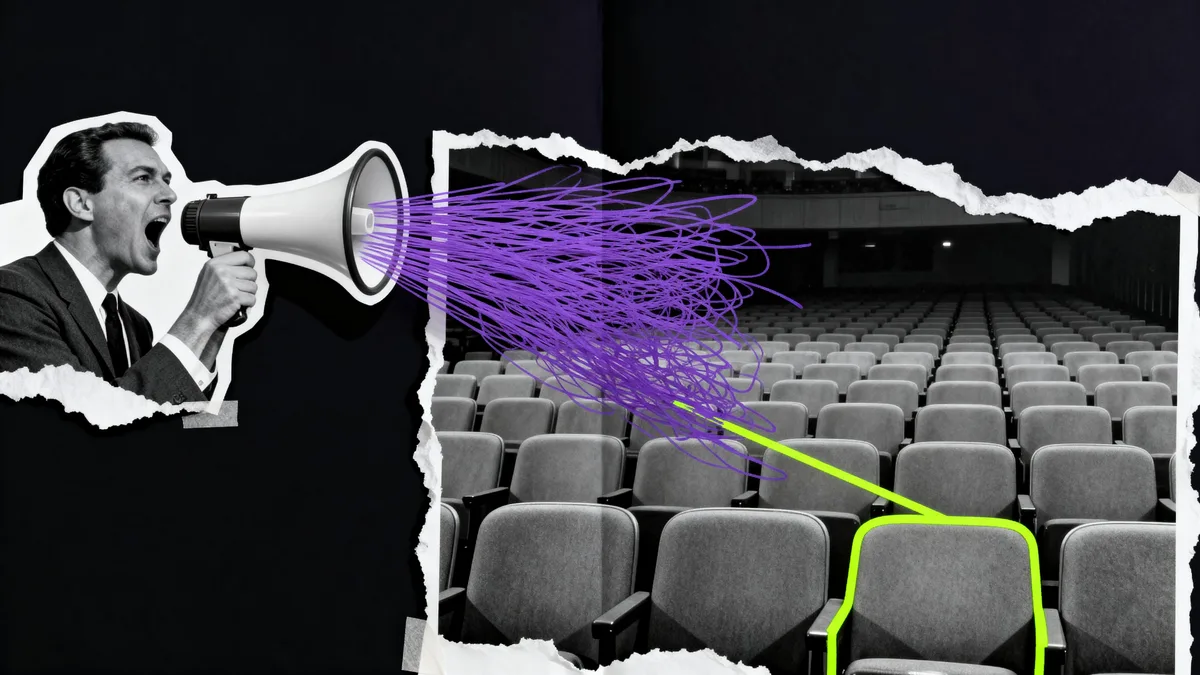











Influencer reports can look impressive very quickly. A few million views, a strong engagement rate, screenshots of comments and a line saying the campaign “performed above benchmark.” The difficult question comes one slide later: what did it actually change?
That question is becoming harder to avoid. IAB’s 2026 creator-economy measurement work says creator investment is growing faster than the systems used to measure it, with fragmented metrics and proxy-based ROI still making it difficult to compare creator activity with other media. The answer is not to stop using platform metrics. It is to stop asking them to prove things they were never designed to prove.
What do likes and views actually tell you?
They tell you something about distribution and response to the content, not the whole business effect. A view can indicate exposure. A like can indicate a lightweight reaction. A comment can contain valuable qualitative signal. None of them, on their own, prove that awareness increased, perception changed, people searched for the brand, a customer bought, or the sale would not have happened without the creator.
This is why influencer measurement should work like a ladder. Start with content delivery, then move toward customer behavior and business impact. The closer you get to the bottom of the funnel, the stronger the evidence needs to become.

Start with the objective, not the metric
Before briefing a creator, write the one thing the campaign is supposed to change. “We want engagement” is not enough. Do you need people to discover a new product, remember the brand, consider it, visit a page, install an app, buy, visit a store or create reusable content for paid media?
| Campaign objective | Primary evidence | Useful supporting metrics |
|---|---|---|
| Awareness | Reach + brand lift | Video views, view-through, frequency, ad recall, brand search |
| Consideration | Intent / favorability lift + qualified traffic | Saves, shares, product-page visits, time on site, searches |
| Conversion | Tracked orders + conversion lift where possible | Clicks, add-to-cart, code use, CPA, ROAS |
| Retail / store | Incremental sales or store-visit lift | Product searches, retailer traffic, code redemptions |
| Content production | Asset performance and reuse value | Hook/retention, paid-media results, editing/reuse efficiency |
The objective decides what “good” evidence looks like. A creator can be excellent at awareness and weak at direct-response sales. Another can generate small reach but strong qualified traffic. Comparing them on one universal engagement-rate benchmark can hide what each one is actually good at.
Build a measurement stack instead of one KPI
Layer 1: Delivery and attention
Start with reach, impressions, video views, watch time, completion rate and frequency. These metrics answer whether the content was actually delivered and whether people stayed with it. They are the beginning of the story, not the end.
Layer 2: Quality of response
Look beyond the total engagement count. Saves, shares, meaningful comments, profile visits and product questions can be more informative than low-friction likes. Read the comments as research: are people asking where to buy, comparing shades, questioning price, tagging friends or misunderstanding the message?
Layer 3: Traffic and on-site behavior
Give every creator or creative variation a disciplined tracking setup. Google Analytics recommends consistent UTM parameters so campaign traffic does not fragment across reports. At minimum, standardize source, medium, campaign and content naming. Then look at sessions, product-page visits, key events and downstream conversion quality.
Layer 4: Conversion and revenue
Affiliate links, promo codes, checkout attribution, pixels, app measurement and CRM matching can connect creator activity to orders or leads. But last-click revenue is not the same thing as total impact. A person may discover the product through a creator, search later, buy through a retailer or convert after seeing paid retargeting.
Check out what our CEO is writing about: The problem with 360 marketing when there is no strategy
Layer 5: Brand lift and incrementality
When the budget and scale justify it, move from correlation toward experiments. TikTok’s Brand Lift Studies use exposed and control groups to estimate changes in measures such as awareness, ad recall and purchase intent. Its Conversion Lift and Unified Lift products are designed to estimate incremental conversion impact rather than simply crediting observed conversions.
The distinction matters. Attribution asks, “Which touchpoint gets credit?” Incrementality asks, “What happened because we ran the campaign?” Both are useful, but they solve different problems.
Layer 6: Content value after the original post
Influencer content often keeps working after the organic post has peaked. The asset may be whitelisted or amplified as paid social, used on a product page, adapted for retail, placed in email or reused in a broader campaign. CreatorIQ’s 2026 research says creator content is increasingly being used across paid and commerce environments, which means the campaign should measure the content asset as well as the creator post.
What should you track for each creator?
| Metric group | Track per creator | Why it matters |
|---|---|---|
| Cost | Fee, usage rights, production, amplification | Shows the real investment, not only the talent fee. |
| Delivery | Reach, impressions, views, frequency | Confirms how much audience exposure was created. |
| Attention | Watch time, completion, hold rate | Shows whether the creative kept people long enough to land the message. |
| Response | Saves, shares, comments, profile visits | Provides stronger intent or qualitative signals than likes alone. |
| Traffic | UTM sessions, product visits, key events | Connects creator activity to owned properties. |
| Commerce | Orders, revenue, code/affiliate sales, CPA | Shows directly tracked business outcomes. |
| Lift | Brand lift, conversion lift, store/sales lift | Estimates incremental effect when study design allows. |
| Asset value | Paid-media performance, reuse count, usage window | Captures value created beyond the original post. |

How do you compare creators fairly?
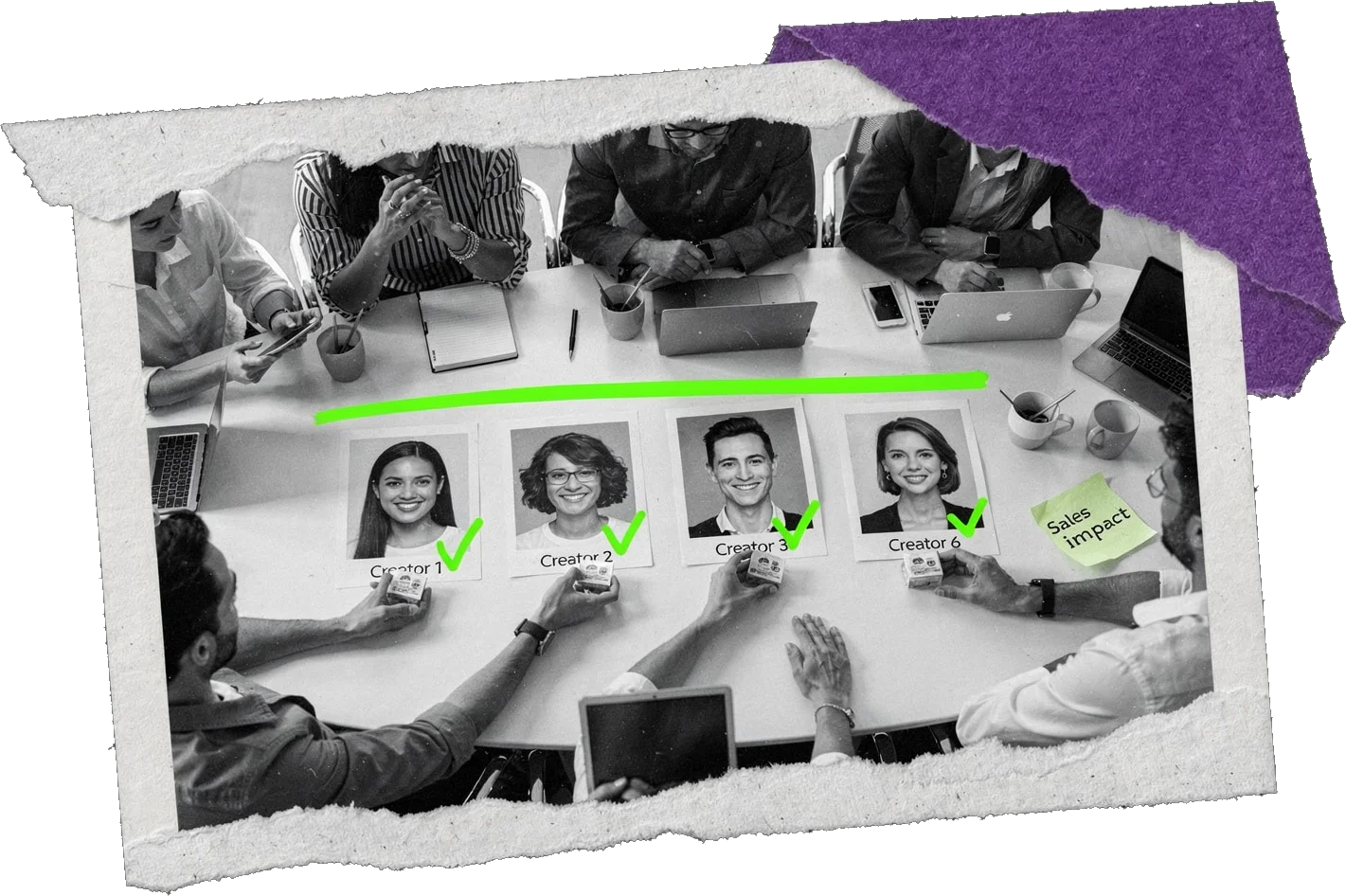
Do not rank creators on raw totals without context. A large creator will usually generate more views than a smaller one because you bought access to a larger audience. Normalize the numbers around the job you hired them to do.
- For awareness, compare efficient qualified reach, attention and lift rather than only total views.
- For traffic, compare cost per qualified visit and what those visitors do after landing.
- For conversion, compare cost per incremental or attributed outcome while watching margin and return quality.
- For content, compare which creator assets perform when amplified, reused or tested against brand-produced creative.
- For audience fit, inspect geography, demographics, category relevance and comment quality instead of trusting follower count.
How do you set up tracking before the campaign launches?
- Name the business objective. Write the outcome in one sentence and agree on the primary KPI before content is approved.
- Define the measurement window. Decide how long after exposure or click you will observe traffic, conversion or sales effects.
- Create consistent UTM conventions. Use the same source, medium and campaign rules for every creator and use content-level parameters to separate individual assets.
- Give creators unique links or codes when appropriate. These are useful direct-response signals, but do not assume they capture every sale influenced by the campaign.
- Make sure conversion tracking works. Test website events, app events, checkout, pixels, server-side events and CRM capture before launch, not after the report is due.
- Plan the lift study early if you need one. Control-group studies need setup before or during the campaign. They cannot be perfectly reconstructed later from screenshots.
- Record usage rights and reuse plans. If the creator asset will become paid media or website content, include that value and performance in the measurement plan.
What should the final report show?
A useful report should make the next decision easier. Leadership does not need twenty pages of screenshots unless those screenshots explain something. Start with the objective, total investment, the strongest evidence of impact, what did not work, what you learned about creators or audiences, and what you recommend changing next.
| Report line | Question it should answer |
|---|---|
| Objective | What were we trying to change? |
| Investment | What did the campaign really cost, including rights and amplification? |
| Delivery | Did the intended audience actually see the content? |
| Impact | What changed in awareness, behavior, conversion or sales? |
| Incrementality | What evidence suggests the outcome would not have happened anyway? |
| Creative learning | Which creator, message or format should we scale or stop? |
| Next decision | What are we doing differently because of this result? |
Five common measurement mistakes
- Using engagement rate as the business case. It can help evaluate content response, but it does not replace business outcomes.
- Changing the KPI after the campaign. If the sales campaign misses sales and the report suddenly celebrates views, the measurement plan failed.
- Treating promo-code revenue as total influence. It is useful tracked revenue, but it can undercount customers who buy another way.
- Mixing organic and paid amplification without separating them. Creator content and media distribution are different investments and should be visible in the report.
- Reporting numbers without a decision. A measurement framework is only useful if it changes who you hire, what you brief, where you spend or what you stop.
A practical rule for smaller campaigns
Not every influencer campaign needs a sophisticated incrementality study. If the budget is modest, start with disciplined UTMs, unique links or codes, correct conversion tracking, clear campaign objectives, creator-level cost data and a short post-campaign read of sales and customer behavior. The point is to improve the evidence as the investment grows.
The goal is not to prove that every creator “worked.” It is to learn which creator, message, audience and distribution model deserves the next dollar.