










A full room is satisfying. A long registration list looks good in a report. Neither one answers the question leadership eventually asks: what changed because we ran this event?
That question matters more in 2026 because event budgets are under heavier scrutiny and the measurement standard is moving closer to pipeline, revenue and business outcomes. Cvent’s 2026 Event-Led Growth research, based on more than 1,000 marketers in the US and UK, says teams using an event-led growth approach are 47% more likely to rank events as their top-performing channel. At the same time, Bizzabo reports that 40% of event organizers still struggle to prove ROI. The opportunity is large, but the reporting has to catch up.
Why are registrations and attendance not enough?
Because they tell you whether the event attracted people, not whether it changed anything that matters to the business. A registration can be a useful demand signal. Attendance can show that the topic, timing and experience were strong enough to get someone into the room. But a person can attend, enjoy the event and never become more likely to buy, renew, partner, recommend or take the next step.
The same logic works in the other direction. A small executive roundtable with 25 carefully selected people can create more commercial value than a conference with 2,500 attendees. Event measurement has to reflect the job the event was designed to do.
The question is not “how many people came?” It is “what moved because they came?”

What should event ROI actually measure?
Use a measurement ladder instead of one headline number. Each layer answers a different question, and not every event needs to reach the revenue layer immediately.
| Layer | Question | Examples |
|---|---|---|
| 1. Audience quality | Did the right people register and attend? | Target accounts, seniority, customer/prospect mix, geography, fit |
| 2. Engagement | Did they actively participate? | Session attendance, meetings, questions, scans, content interactions, dwell time |
| 3. Relationship / intent | Did the event change interest or confidence? | Follow-up requests, demos, partner interest, brand or trust signals |
| 4. Qualified conversations | Did useful commercial conversations happen? | Sales-accepted leads, meetings, next-step commitments, opportunity creation |
| 5. Pipeline movement | Did existing or new opportunities progress? | Stage movement, deal velocity, influenced pipeline, expansion opportunity |
| 6. Revenue / economics | Did measurable financial value follow? | Closed-won revenue, contribution margin, sponsorship revenue, cost efficiency |
| 7. Strategic value | What else did the business gain? | First-party data, customer insight, content assets, partner relationships, employee learning |
The ladder keeps teams from forcing every event into one metric. A product launch may prioritize qualified demand and product understanding. A customer summit may care more about retention, expansion and advocacy. A trade show can be judged on target-account access and opportunity progression. A community event may intentionally optimize for trust and participation first.
Check out what our CEO is writing about: Stop selling deliverables. Solve the business problem
Start measuring before the event opens
The biggest measurement mistake is waiting until the post-event report to decide what success means. Cvent’s 2026 ROI guidance makes the same point: ROI works best as a planning discipline, not an afterthought. If the objective is vague before the event, the data will be vague after it.
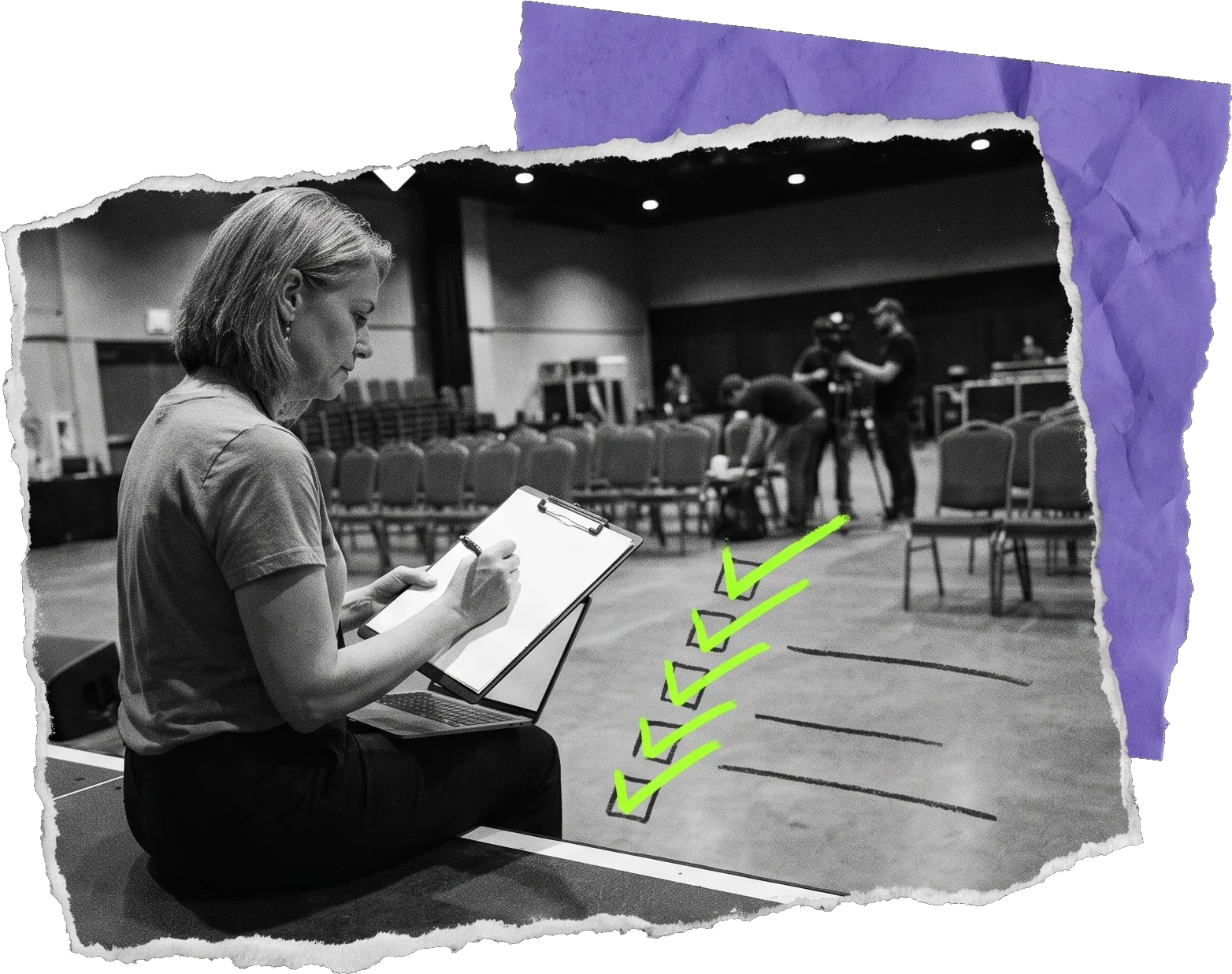
- Write the business objective. Examples: create qualified pipeline, accelerate strategic accounts, support a launch, improve customer retention, build partner relationships or gather customer insight.
- Define the behavior you expect to change. What should an attendee do differently after the event: request a meeting, progress an opportunity, renew, trial a product, introduce a partner or advocate internally?
- Choose the evidence. Decide what data would show that the behavior changed and where that data will live.
- Set attribution rules. Agree what counts as event-sourced, event-influenced and unrelated. Do this before anyone sees the results.
- Plan the follow-up. Name the owner, response time, CRM status and next action for every important signal the event creates.
What should you measure before, during and after the event?
| Phase | Signals | Decision |
|---|---|---|
| Before | Target-account coverage, registration conversion, audience fit, meeting bookings, acquisition source | Is the right audience likely to be in the room? |
| During | Check-ins, sessions, meetings, interactions, questions, scans, demos, sponsor engagement | Where is interest strongest and who needs a next step? |
| 0-14 days after | Follow-up completion, accepted leads, demo requests, content use, surveys, opportunity creation | Did event energy turn into action? |
| 30-90+ days | Pipeline progression, deal velocity, closed-won, expansion, retention, partner outcomes | Did the event create or accelerate business value? |

How should you calculate financial event ROI?
Use the financial value that best reflects the business, and be explicit about the assumptions. A simple formula is: (incremental value generated - total event cost) / total event cost x 100. Where possible, use contribution margin or another profit-based value rather than gross revenue, because revenue alone can overstate the economic return.
The difficult part is rarely the formula. It is deciding what value can credibly be attributed to the event. A sponsorship payment is direct. A deal created from a meeting booked at the event is relatively clear. A deal that had been progressing for eight months before an attendee walked into one session needs a more careful definition of “influenced.”
How do you track pipeline influence without inflating the story?
- Separate sourced from influenced. Event-sourced means the opportunity originated through the event. Event-influenced means the event touched an opportunity that already existed.
- Record the meaningful interaction. Attendance alone is weak evidence. A scheduled meeting, product demo, executive conversation or agreed next step is stronger.
- Use time windows carefully. The right window depends on the sales cycle. A two-week window may work for a low-consideration offer and be useless for enterprise sales.
- Compare progression. Look at stage movement, deal velocity or conversion among relevant attendees rather than only attaching a large pipeline total to the event.
- Do not turn pipeline into revenue. Keep pipeline, closed-won revenue and incremental value as separate lines in the report.
What about trust, customer insight and first-party data?
They can be legitimate event outcomes, but they need more discipline than a sentence saying “the event strengthened relationships.” Cvent’s 2026 research on trust found that 83% of event and marketing teams had seen scrutiny increase on measurable event returns, while only 28% reported a robust framework for measuring trust. That gap is a reminder that softer outcomes still need a method.
For trust, define observable indicators such as willingness to meet, repeat attendance, advocacy, customer sentiment, partner introductions or movement in pre/post survey questions. For customer insight, document what questions, objections or needs repeatedly surfaced and where those findings changed product, content, sales or service decisions. For first-party data, measure not just how much was collected, but whether it improved segmentation, follow-up or customer understanding.
What should the final event report show leadership?
Keep the leadership version short. The job is to show what the event was meant to change, what evidence moved, what business value followed and what you recommend doing next. The detailed operational dashboard can live elsewhere.
- Objective: the business problem or growth goal the event was designed to support.
- Audience: who attended, whether they matched the target and which important accounts or communities were reached.
- Behavior: what people did during and after the event that signals interest, trust or intent.
- Commercial effect: sourced pipeline, influenced pipeline, opportunity movement, revenue or retention where relevant.
- Strategic value: customer insight, partnerships, content, first-party data or other planned outcomes.
- Economics: total cost, cost per relevant outcome and financial ROI where the data supports it.
- Decision: repeat, change, scale, stop or test something different.
A practical event ROI checklist
- One business objective is written before production begins.
- The target audience and account criteria are defined.
- Success metrics are agreed with marketing, sales and leadership.
- CRM and event-platform fields are mapped before registrations arrive.
- Event-sourced and event-influenced are defined separately.
- Follow-up owners and deadlines are assigned.
- Qualitative learning has a capture method, not just anecdotal notes.
- The post-event report includes a decision, not only a recap.